
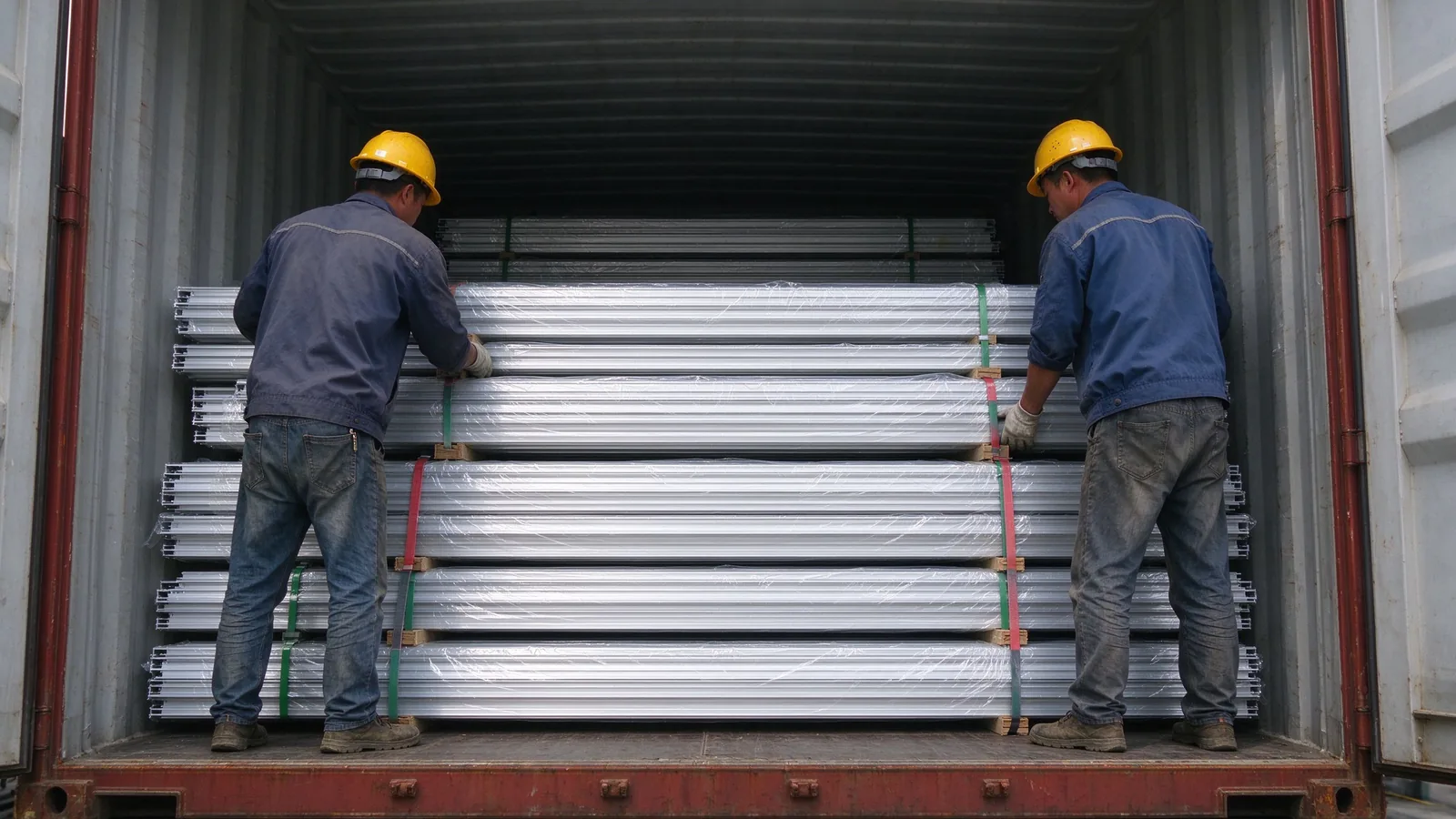
Two documents describe the same shipment: the marks painted on the crates and the lines printed on the packing list. When they agree, unloading takes an afternoon. When they disagree, the container waits at the port, the site waits for the container, and nobody finds out until both are already expensive.
What a mark has to do
A mark is a locating instruction. It has to let a crew find one part among forty without opening everything, and it has to do it in the rain, from two metres away, by someone who has never seen the drawing. That means five pieces of information, in this order of importance:
- Project or order reference — so two shipments for two sites do not get mixed on a shared dock.
- Crate or bundle number — the unit that the packing list is organised around.
- Part reference matching the shop drawing — the same code the crew has on the drawing in their hand.
- Quantity and description — “6 pcs, main beam 150×80, L=4200” rather than “beams”.
- Gross weight and longest dimension — so the forklift and the truck are chosen before arrival, not after.
Handling marks (this way up, do not stack, glass inside) belong on the same label, not on a separate sticker that gets scraped off in transit.
How to make the mark survive
Printed paper labels do not survive a container. Use weather-resistant labels with a printed barcode or QR code, and repeat the crate number on two faces and on the top. Where a mark is painted directly onto a crate, use a stencil rather than a marker, because marker fades and smears. On glass crates, the mark goes on the frame, never on the glass.
If the shipment carries mixed containers, the container number should appear on the packing list next to the crate numbers. When a container is held for inspection, that single field tells the broker which crates to open and which to leave sealed.
Where it goes wrong, and why
The bundle was split at the last minute. A 6 m beam becomes two 3 m pieces to fit a container, and the packing list still says one line. The split part is physically numbered differently and the document is not updated.
A box was added. Touch-up paint, spare fixings, an extra bracket set — small things added after the list was printed. They arrive, they are not on the list, and the customer’s receiving report shows a shortage that is not real.
The revision moved. A drawing revision changed a louvre blade length after packing. The crate number stayed, the contents changed.
Two suppliers, one container. When ranges from different lines consolidate, each line marks its own crates its own way, and the consolidated list has three numbering schemes in it.
The cheap fix: photograph the load
Before the doors close, take four photographs: the load from the door end, the marks on the two nearest crates, the last crates loaded, and the container number with the seal. Store them against the packing list. It takes two minutes and settles most arguments about what was actually shipped, months later, without a surveyor.
The same discipline applies to what is inside a crate. A photo of the open crate with its contents laid out, before it is closed, is the evidence that a part was there when it left — and the difference between a claim that is settled in a week and one that is argued for a season.
Documents that travel with the goods
The packing list, the commercial invoice, the bill of lading, and whatever origin or conformity documents the destination customs broker requires — and they must all carry the same reference numbers. Anything the broker needs but the paperwork lacks becomes a hold; anything the crew needs but the crate lacks becomes an afternoon of opening boxes.
On our shipments the packing list is generated from the same part numbering as the shop drawing, so the crate mark and the drawing line are the same string. If you are comparing suppliers, ask to see one packing list from a previous shipment: how it is organised tells you how the factory thinks. The related note on nine marks to check when the container arrives covers the receiving end of the same process.
Keep reading
EXW, FOB, CIF and DAP for Aluminium Structures
EXW, FOB, CIF and DAP on an aluminium structure order: where responsibility moves, how the term changes packing,…
Read article →
LCL or a full container for an outdoor structure order
It is not only about freight cost. It is about how many times the material is handled before…
Read article →
How an outdoor aluminium structure travels from shop to container
It leaves the shop as a stack of profiles and small parts, and arrives as something a crew…
Read article →Related notes
- Setting posts plumb: the cheapest insurance on a pergola install
- Cleaning a powder-coated surface without damaging it
- From sketch to shop drawing: how the drawing changes before production
Working on a project? Send a drawing and we reply from the Foshan plant with a first price. Not sure which line fits — start from the six product lines.