
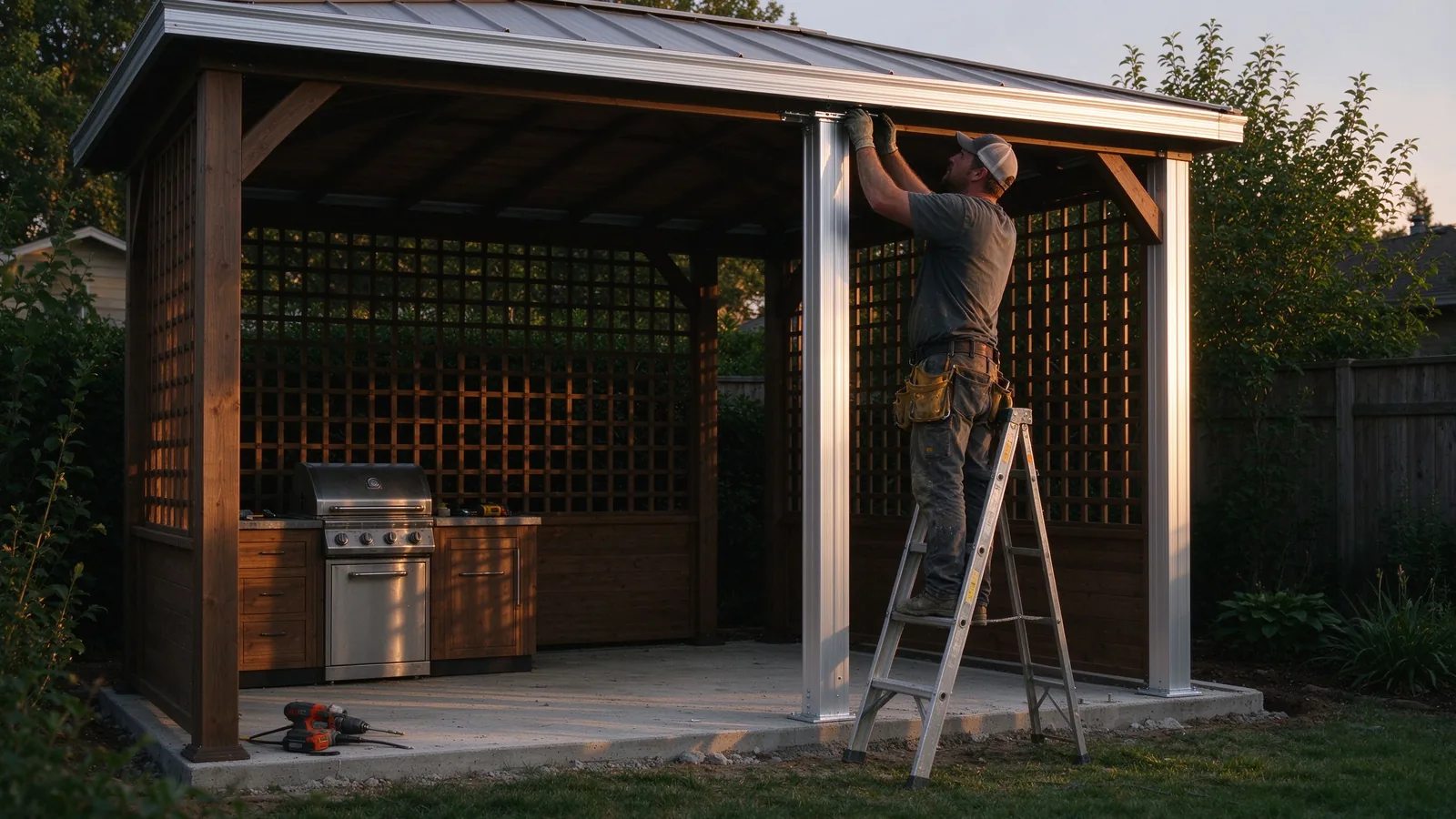
Plumb posts cost almost nothing and fix almost everything. Out-of-plumb posts cost nothing to ignore on the day and cost a great deal later: panels that will not close, glass that is stressed before anyone touches it, water that runs the wrong way, and a structure that looks wrong from twenty metres away even though nobody can say exactly why.
Why plumb matters more than level
Level errors are usually shared across the structure — a slab that falls 10 mm over the whole run moves every post by the same amount, and the frame stays square. Plumb errors are individual: one post leaning 5 mm at the base twists its bay, and the neighbouring bay has to absorb the difference. That is why a single leaning post is visible while a uniformly sloping slab is not.
Three things follow a post that is out of plumb. The roof panels no longer sit square to the beams, so louvre blades bind and fixings fight. Glass, if there is any, is forced into a parallelogram and carries stress it was never designed for. And the water path changes — a fall that was designed as 1 in 20 can become flat in one bay.
Tolerances that are realistic
As a working standard: 2 mm out of plumb per metre of post height, and no more than 6 mm total on a 3 m post. Check with a 2 m level or a laser, reading the bubble at the same height each time, and check in two directions — a post can be plumb in one axis and leaning in the other, and that is the error that survives.
Also check the diagonals of the bay, not just the posts. Two plumb posts with the wrong spacing give a bay that is a parallelogram standing upright. Equal diagonals mean the bay is square.
The sequence that works
1. Set the base plates first, not the posts
Base plates are the adjustable part. Set them, check their centres and their level, and only then stand the posts. Trying to correct a base plate through a 3 m post is the reason installs run long.
2. Brace before you fix
Temporary bracing on two axes, fixed to the slab or to a stable anchor, holds the post while the anchor is set. Without bracing, the post moves when the anchor is tightened and the error arrives after the check.
3. Check, then anchor
Plumb, square, level, and only then tighten or grout. Once a chemical anchor has cured, correcting a post means cutting it out.
4. Check again after the roof is on
A roof that is heavy or that has been assembled on the ground and lifted will move the frame. A final check after the roof is fixed, before the panels go in, catches the movement while it is still cheap.
Anchor types and what they need
Cast-in ferrules are the most forgiving because the position is fixed by the formwork. Chemical anchors depend on a clean, dry, correctly sized hole — on a dusty site, blow the hole out and brush it, twice. Mechanical anchors need the correct torque, and over-torquing splits the concrete around the anchor rather than tightening the fixing. On a slab edge, keep the anchor at least 1.5 times its depth from the free edge.
Base plates should sit on the structural slab, not on a screed or a tile bed. A plate bedded on mortar over a 40 mm screed feels solid on the day and moves within a season.
Six mistakes we see on site
- Correcting plumb by pulling the post against a wall — the wall moves instead.
- Checking plumb only at the base after the anchor is tight; the error is at the top.
- Setting posts to the drawing dimensions without checking the diagonal.
- Anchoring into a screed, a tile bed or a paving slab.
- Leaving bracing off overnight on an exposed site, then finding the frame moved in the morning.
- Fixing the roof before the posts are final-checked.
What this costs
An hour of setting out and bracing, per structure, is the whole cost. The same error corrected after the panels are in means removing panels, releasing anchors, repositioning, and sometimes replacing glass that has been stressed. On our louvered pergolas the louvre blades run on a fixed track, so a twisted bay does not simply look wrong — the blades stop operating.
Our installation sheets carry the plumb and diagonal checks as a sign-off step, because the crew that skips them is the crew that comes back.
Keep reading

What the Installer Needs on Site Before the Crate Is Opened
What an installer needs before the crate is opened: pads cured, access clear, the right drill and anchor…
Read article →
Setting Out a Bay: Square, Level and Fall in One Pass
Setting out a pergola bay: check square with diagonals, level posts from one datum, build the fall in…
Read article →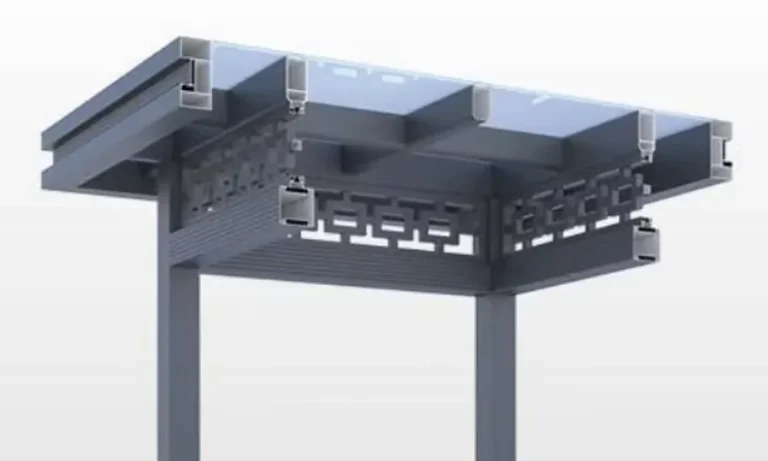
Installation Sequence for a Louvered Pergola
Installation sequence for a louvered pergola: set out, plates and posts, beams and wall plate, blades, drive limits,…
Read article →Related notes
- Cleaning a powder-coated surface without damaging it
- From sketch to shop drawing: how the drawing changes before production
- Why two suppliers quote different prices for the same drawing
Working on a project? Send a drawing and we reply from the Foshan plant with a first price. Not sure which line fits — start from the six product lines.