
Motorized vs Manual Louvered Pergola: The Honest Cost Difference
The manual to motorized step is usually quoted as an upgrade percentage, and buyers treat it as a comfort option. In practice it changes how often the roof is actually adjusted, which decides whether a louvered pergola earns its cost at all.
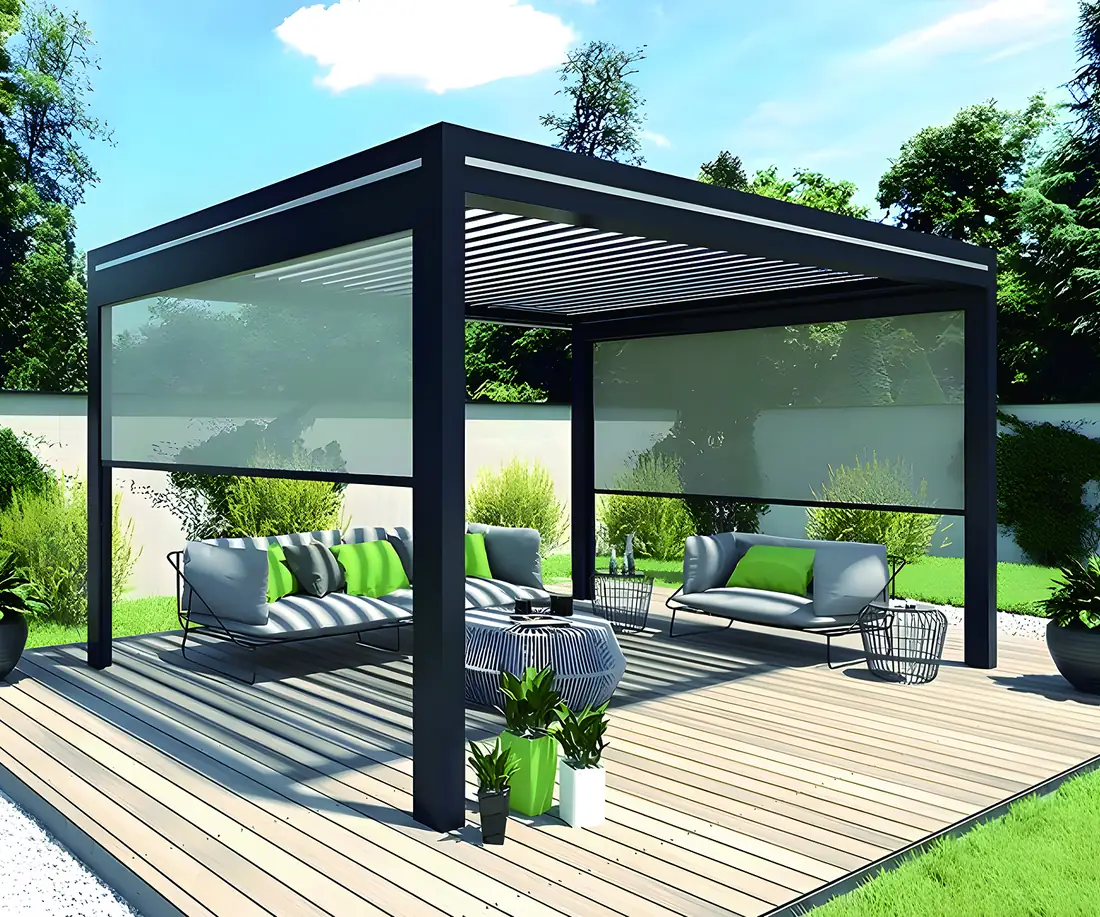
What the motor adds
A tubular motor inside the beam, a receiver, a remote, wiring, and the limit switches that stop the blades at flat closed and fully open. On a wide bay the motor also brings a stronger blade section, because the drive has to move more weight without flex.
Where the cost actually sits
Motor cost is the visible part. The invisible parts are the wiring route to a power point, the number of zones, and the fact that each zone needs its own motor and its own switch. A three-bay roof motorized as one zone costs far less than the same roof with three independent zones, and the difference is in the controls, not the motors.
What the motor changes on site
The change that matters is behavioural rather than mechanical. A manual roof is adjusted when someone walks out and decides to; a motorised one is adjusted when the weather asks. On a wet site that means a motor with a rain sensor closes the roof whether or not anyone is home, and the terrace is dry when the family returns instead of wet for the evening.
There is a second effect on installation. A motor needs a route and a power point, and both are decided before the concrete. A manual roof can be installed on a terrace with no electrical provision at all, which suits a garden where the nearest socket is twenty metres away and running a cable would cost more than the motor.
Zones, sensors and the wiring route
A zone is one motor driving one group of bays. One zone over a terrace is simple and cheap; separate zones let a dining end close while a lounge end stays open, which is the layout most restaurants and hotels want. Each extra zone adds a motor, a receiver and a switch, so the cost is linear in zones rather than in area.
Sensors belong with the motor, not after it. A rain sensor is wired into the control, a wind sensor likewise, and both need a place to live that is not on the blades. Deciding “rain sensor, one zone, power at the north post” at quotation stage makes the electrical drawing possible; deciding it later makes it a retrofit.
What fails, and how it is fixed
In practice motors fail at the ends of their travel: limit switches drift, and a roof that once stopped flat starts to over-travel and stalls. That is an adjustment, not a replacement. The other common failure is water in the receiver or the connector, which is a sealing issue rather than a motor issue.
The maintenance question to ask any supplier is whether the motor can be reached and replaced without removing the beam, and whether the manual override works when the power is out. A roof you cannot close by hand in a power cut is a roof that stays open in the storm that caused the cut.
Manual is right in these cases
A small bay, a garden room used on weekends, a structure where the owner is always present, and a project where there is no reliable power at the terrace. Manual louvres with a crank or a rod are reliable and repairable, and there is nothing to fail in a storm.
Motorized is right in these cases
Any roof above roughly three metres of span, where closing by hand is a two-person job. A roof over furniture that must close fast when rain starts. A roof the owner wants to open from inside the house. A roof with a wind or rain sensor, which only makes sense with a motor.
The question to ask
Not “how much more is the motor”, but “how many zones, and how do I want to operate them”. Answer that and the price difference becomes a number you can judge rather than a percentage you have to accept.
The number that decides it
If the honest comparison is how often the roof is adjusted, then the decisive figure is not the upgrade price but the number of days a year the terrace would otherwise be left open in rain. In a wet climate that is dozens; in a dry one it may be five. Multiply those days by the annoyance and the motor usually pays for itself sooner than the buyer expects.
Explore the range: Louvered Pergola — sections, finishes and the drawings we send with a quotation.
Keep reading
Sample, Trial Order and MOQ for Aluminium Structures
Sample, trial order and MOQ on aluminium structures: what a trial proves, why one set costs more per…
Read article →
Glass Sliding Doors under a Louvered Roof
Glass sliding doors under a louvered roof: track and threshold, roof fall versus door head, glass weight and…
Read article →
City-Centre Installations: Access, Permits and Working Hours
City-centre pergola installation: access route before price, what triggers a permit, working hour limits, waste, and setting out…
Read article →Related notes
- Wind and Snow Load: The Three Numbers Buyers Forget to Send
- Nine Marks to Check When Your Container Arrives
- How to Read a Shop Drawing Before You Approve It
Working on a project? Send a drawing and we reply from the Foshan plant with a first price. Not sure which line fits — start from the six product lines.