Blade Angle Explained: How Much Shade a Louvre Roof Really Gives
Buyers ask for “full shade” and expect a louvered roof to deliver it. What the roof actually delivers depends on three numbers: blade width, the tilt range, and how much the blades overlap when closed. Understanding them stops a surprise at the first hot afternoon.
Blade width sets the stripe pattern
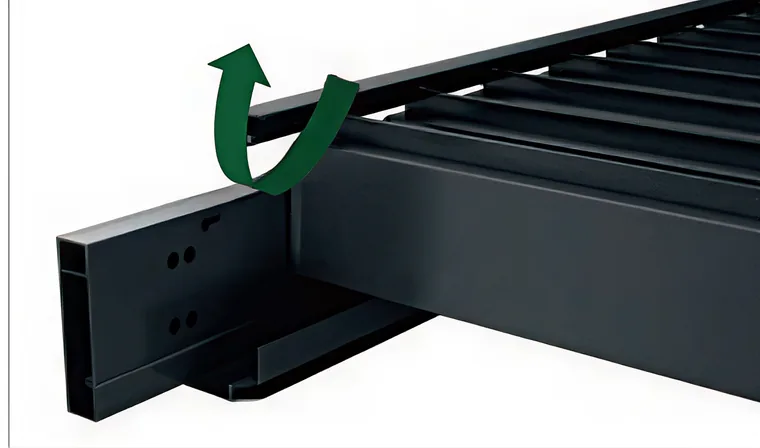
Wider blades throw a broader shadow and a coarser stripe; narrow blades give a finer pattern with more light between them. In practice blade widths around 150 mm are the common choice, because they shade well without making the roof look heavy from below.
Angle sets the time of day
Blades near horizontal block high midday sun and let low evening sun under the roof. Tilted toward vertical, they cut the low sun but open the roof to the sky above. A roof with a full tilt range — roughly a hundred degrees from closed to near vertical — can be set for the hour, not just the season.
Overlap decides rain performance
Closed blades must overlap, not merely touch. Overlap plus a fall to the ends is what sends water into the perimeter gutter instead of through the joints. A louvered roof sold without a gutter and a fall is a shade structure, not a rain roof.
Midday, dusk and the angle that matters
At midday the sun is high and a nearly horizontal blade does the work: it intercepts the light and throws a short stripe. Late in the afternoon the sun is low, and the same blade lets the light straight under the roof and across the seating. The complaint “the pergola does not shade in the evening” is almost never a blade problem; it is the angle, and it is fixed by tilting the blades toward vertical.
The reverse complaint happens in winter, when a vertical blade cuts the low sun that a terrace actually wants. A roof with a full range solves both: horizontal for summer noon, vertical for the low sun, and anything in between for the hours people actually sit outside.
When shade is not the point
Some terraces are built for the light rather than against it. A garden room that is too shaded becomes cold and looks closed; a restaurant terrace that is entirely blacked out loses the reason customers sat outside. In those cases a partly open setting is the better default, and the blades are adjusted around the day rather than closed by habit.
That is worth deciding before the motor is specified, because a roof that is adjusted twice a year sells differently from one that is adjusted twice a day.
Motor, sensor and the daily setting
The right setting most owners settle on is blades at about a third open for daily use, closing fully before rain. That is why the motor and the sensor matter more than the blade size in daily life.
A rain sensor on a motorised roof is not a luxury on a wet site; it is the difference between a roof that is usually open and a roof that is usually closed because nobody was home. A wind sensor works the same way in the other direction, closing the roof before a partly open blade starts to chatter.
What “full shade” should mean in a quote
Ask for the shade coverage at a stated sun angle, and ask what the gap between blades is when closed. A supplier who can answer both is describing a roof; one who answers “very shady” is describing a picture.
The stripe pattern and how it reads
The shadow a louvered roof casts is part of how the terrace looks, not only how it performs. Coarse stripes from wide blades read as architecture and suit a structured planting scheme; the fine pattern from narrow blades reads as texture and can look busy above a small table. On a photographed terrace, the pattern is often the first thing a client sees and the last thing anyone specifies.
If the property is being photographed for sale or for a brochure, it is worth setting the blades for the shot: part open, angle chosen so the stripes fall across the seating rather than across the empty end of the terrace.
The gap between blades when closed
Two roofs that both close can still differ in what gets through. A few millimetres of designed overlap at the blade edge is what stops water and stops a stripe of light at noon; blades that simply meet have a hairline gap that shows up as a bright line in the middle of the day and as a drip line in rain.
Explore the range: Louvered Pergola — sections, finishes and the drawings we send with a quotation.
Keep reading
Sample, Trial Order and MOQ for Aluminium Structures
Sample, trial order and MOQ on aluminium structures: what a trial proves, why one set costs more per…
Read article →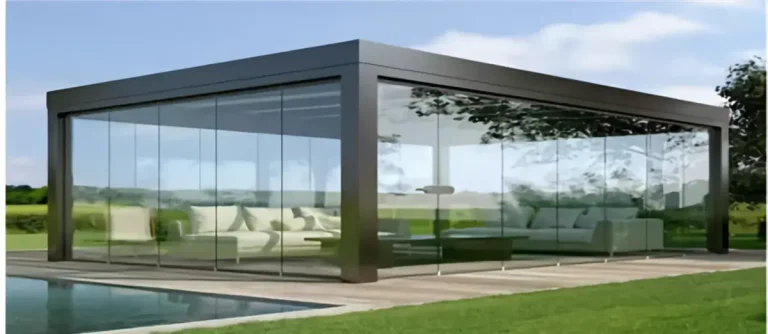
Glass Sliding Doors under a Louvered Roof
Glass sliding doors under a louvered roof: track and threshold, roof fall versus door head, glass weight and…
Read article →
City-Centre Installations: Access, Permits and Working Hours
City-centre pergola installation: access route before price, what triggers a permit, working hour limits, waste, and setting out…
Read article →Related notes
- Motorized vs Manual Louvered Pergola: The Honest Cost Difference
- Wind and Snow Load: The Three Numbers Buyers Forget to Send
- Nine Marks to Check When Your Container Arrives
Working on a project? Send a drawing and we reply from the Foshan plant with a first price. Not sure which line fits — start from the six product lines.