
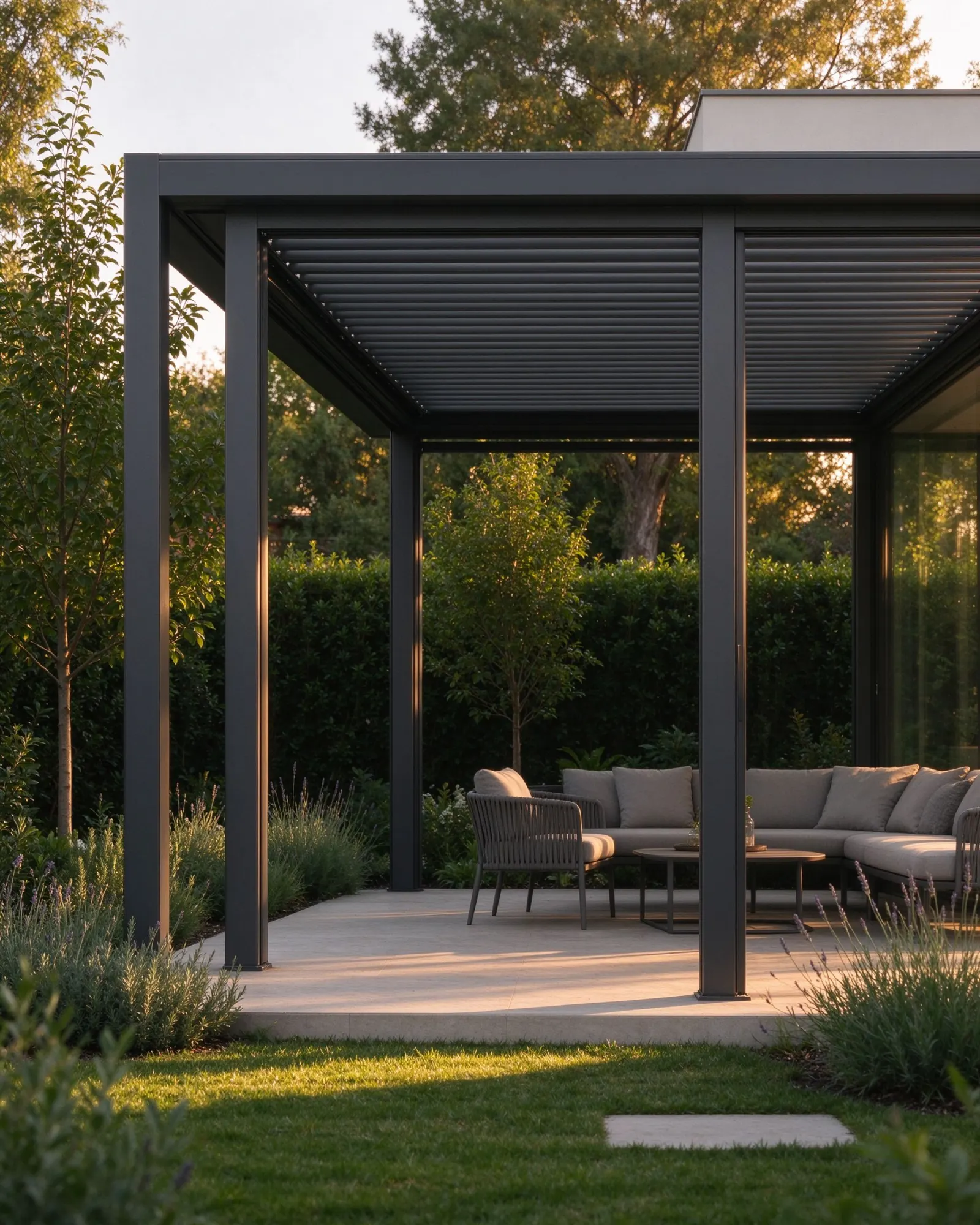
Louvered Pergola Cost per Square Metre: What Moves the Number
A buyer asking for a louvered pergola price per square metre is asking a fair question, and the honest answer is that no factory can give one number per square metre that survives contact with a real bay. Two roofs of the same footprint can differ by half on price, and the difference is almost never in the blades. It is in the span, the posts, the base type, the finish and what has to happen around the edges.
This note works through what actually moves the number, so a first budget can be built from the drawing rather than from a rival’s headline rate.
Why a rate per square metre is a weak unit
A square metre of louvered roof contains a fixed amount of blade and a variable amount of everything else. Blade cost scales with area, roughly, because blades run the length of the bay at a fixed spacing. Beam, post and motor cost scale with the number of bays and the span, not with area. A single 4.5 by 3 metre bay and a 2.25 by 6 metre bay can cover the same area with very different amounts of steel in the frame.
That is why our own specification table runs three span classes rather than a single rate: 3 by 4 metres, 3.5 by 5 metres and 4.5 by 6.5 metres. The maximum bay grows, and so does the section of the blade, the beam and the post that carries it.
The five lines that decide a pergola price
- Number of bays and their sizes. A 6 by 5 metre roof is cheaper as one 3 by 5 twice than as a single 6 by 5 span, because the middle beam and posts come back into play.
- Section class. The heavy-duty class uses 220 by 45 blades, 220 by 142 beams and 160 by 160 posts; the manual class uses 160 by 29, 140 by 100 and 110 by 110. The material weight difference is the biggest single line after area.
- Mounting type. A freestanding roof on four posts needs four bases and four anchor sets. A wall-mounted roof needs two posts, a wall plate and a fixing detail that has to suit the wall it meets.
- Drive. Hand crank, one motor, or two motors on a double bay. Motors add cost but also add a control box, a wiring route and a limit-setting step on site.
- Finish. Standard powder coat in a stock colour versus a custom RAL batch, and wood-grain transfer on top of that.
What the price does not include, and why that matters
Freight, duty, destination handling and installation labour are almost never inside a factory rate. A rate that looks 15 per cent lower can be 30 per cent more expensive delivered if it ships LCL with weak packing and arrives with two scratched bays.
We quote per project rather than per series for exactly this reason: span, series, accessories, quantity and destination port all move the total, and publishing a headline rate would only invite a comparison that is not like for like.
How to build a budget before you have a quotation
Start from the drawing, not from a rate. Fix four numbers first: the bay width, the bay depth, the number of bays and the mounting type. With those four, any factory can price a structure in a day. Without them, every quote is a guess with a margin added.
Then decide which items are in scope. Glass sliding doors, zip screens, LED strips and side slats are separate lines. Each is priced against the bay it hangs on, so adding them later means re-drawing the bay rather than adding a line to an order.
The comparison that is worth doing
Ask two suppliers for the same drawing in the same section class, and compare the quotation line by line rather than the total. Blade section, beam section, post section, base type, blade count per bay, motor count, coating system and packing method. If one quote is missing a line, it is not cheaper; it is incomplete.
Send the bay width and depth with a photo of the site, and a first price comes back with the questions that are still open. That is faster than arguing about a rate per square metre that nobody can hold.
What a good price request contains
One email with five items gets a usable number: a sketch or photo with bay width and depth, the mounting type, the colour, whether the drive is manual or motorised, and the destination port. Add the height from ground to the underside of the beam if there is a wall or an existing structure to clear, and note whether the ground is concrete, paving or decking. Those are the only facts that change the price materially.
Photographs of the site are worth more than a description. A wall that is described as brick can be a single-skin wall with no cavity, a rendered block wall or a 60 mm insulated panel, and each needs a different plate and anchor. A photo settles it in one look.
Related: what a pergola quotation should list, line by line.
Next step: the three series and their specifications are on the louvered pergola product page. If you already have bay sizes, send them through the contact form for a first price.
Keep reading
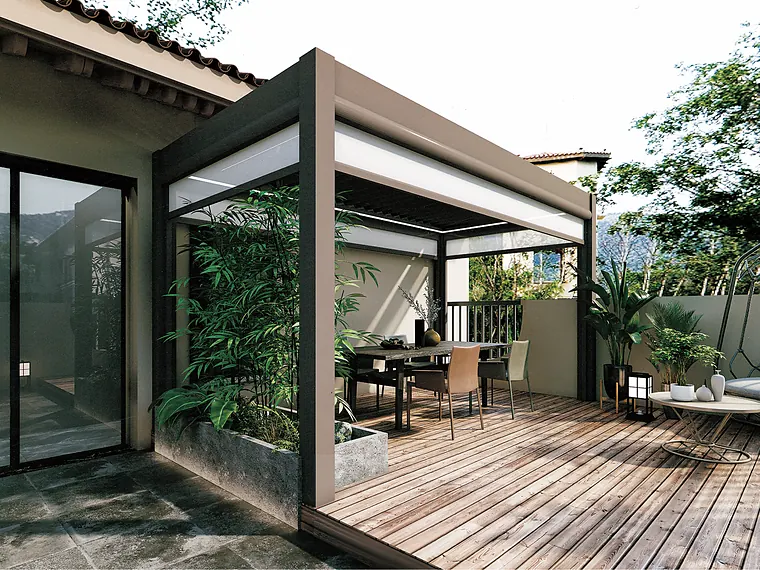
How to Budget an Aluminium Pergola Project in Five Lines
Budget an aluminium pergola project: the five lines that set the price, where projects overspend, and what to…
Read article →
Deposit and Balance: Payment Terms on an Aluminium Structure Order
Payment terms on an aluminium structure order: deposit and balance, what the documents trigger, L/C when it makes…
Read article →
Wind and Snow Load: The Three Numbers Buyers Forget to Send
A frame sized for a sheltered garden and a frame sized for a coastal terrace look identical in…
Read article →Related notes
- LCL or a full container for an outdoor structure order
- Packing list marks: why the crate and the list must agree
- Setting posts plumb: the cheapest insurance on a pergola install
Working on a project? Send a drawing and we reply from the Foshan plant with a first price. Not sure which line fits — start from the six product lines.