
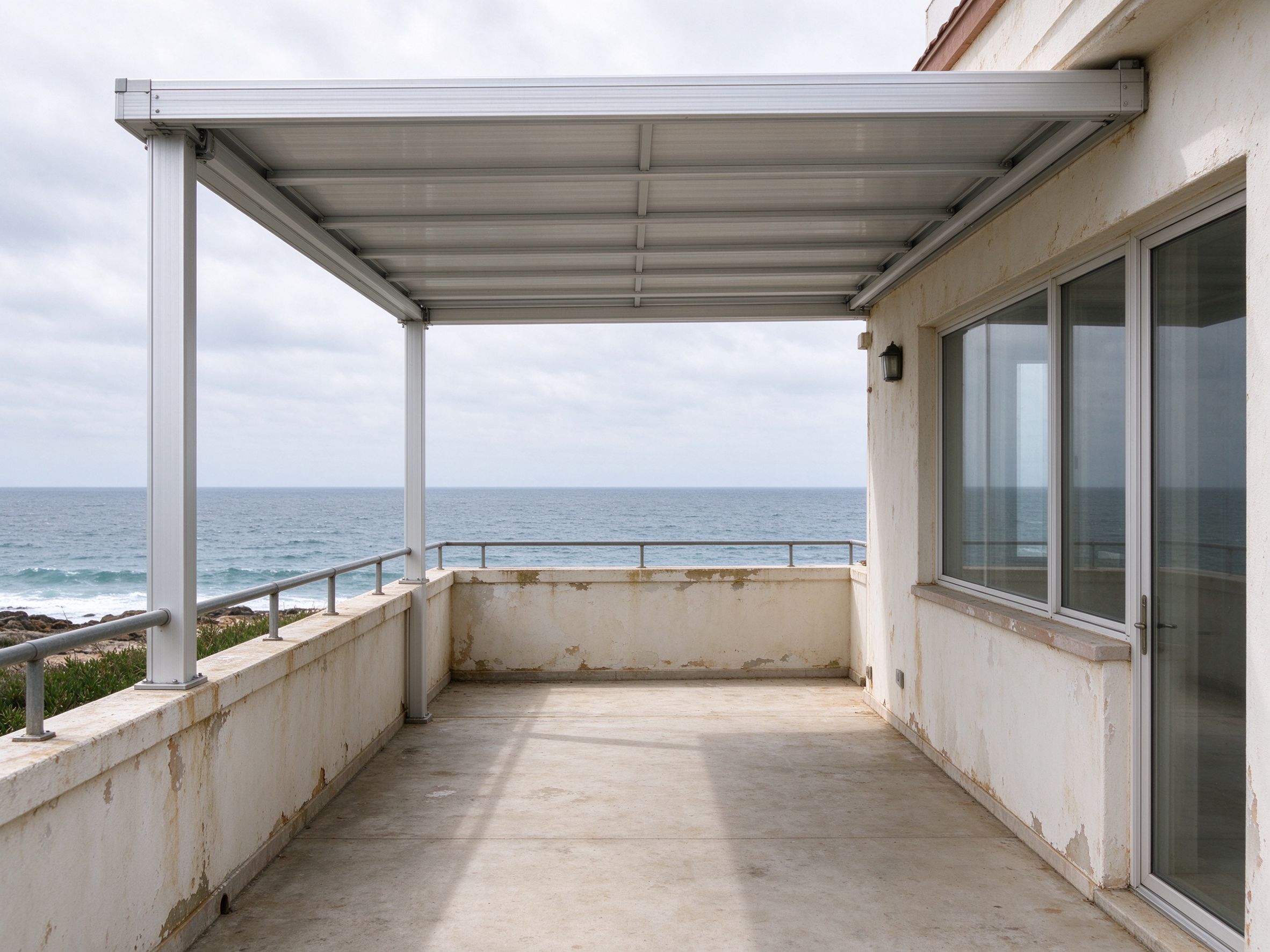
Coastal Installations: Salt Air, Fixings and the Five-Year Check
A coastal site is where an aluminium pergola earns its reputation or loses it. Salt air attacks the two things that fail silently: the coating system and the fasteners. The frame itself is 6063-T5 aluminium and does not rust, which is why the material choice is right; what fails on a coast is the interface between the frame and everything bolted to it.
What salt actually does
Salt spray deposits chlorides on every surface the wind reaches. On a powder-coated profile the chloride sits on the coating and does nothing until the coating is breached — a scratch, a cut edge, an uncoated fastener. Once the coating is broken, the aluminium under it forms a white oxide that creeps under the film and lifts it. That is the blister a client notices two summers later, and by then it is a repaint rather than a touch-up.
On stainless steel the story is different. Grade 304 is the usual default and it holds up inland; within a few hundred metres of the sea, chlorides attack 304 and it shows as tea-coloured staining and, eventually, pitting. Grade 316 is the specification that belongs on a coastal job.
The five details a coastal job needs
- 316 stainless fasteners, not 304 and never galvanised. Every bolt, screw and anchor that is exposed.
- Coating on cut edges. Profiles cut on site expose bare aluminium; the touch-up paint has to be applied, not left in the box.
- Drainage that runs. Salt water that sits in a gutter or on a blade leaves a deposit that holds moisture against the coating.
- Isolation between dissimilar metals. Aluminium against steel or against a galvanised plate needs a barrier washer, or the aluminium becomes the anode.
- A wash schedule. Fresh water, two or three times a year, before the deposit builds.
Why the base matters more at the coast
Uplift is higher on an open shoreline than in a garden, so the plate and the anchor are working harder on the detail that is least visible. A base plate that is fine inland can be undersized on a sea-facing terrace. The anchor set should be chosen from the wind requirement and confirmed against the substrate, and on a coastal site the substrate is often a raised terrace over a slab rather than a slab at grade.
Colour and finish at the coast
Finish is not only a look. A darker powder coat hides the tea-coloured staining that chlorides leave on light surfaces, and a wood-grain transfer film needs to be a UV-stable exterior grade rather than a decorative interior one. Ask what the film is rated for and for how long, and ask how the cut ends will be finished: a profile cut on site with a bare end is the first place the oxide starts.
The other finish decision is the underside. On a coastal terrace the roof is seen from below as much as from the house. A coating system applied in one batch to both directions avoids a roof that looks like two different colours in different light.
What a coastal buyer should photograph
Three photographs settle most of the specification: the shoreline from the terrace, so the exposure is visible; the ground where the plates will land, with a tape in the frame for scale; and the wall where a plate would be fixed. Send them with the bay sizes and the answers come back with the fixing detail attached, rather than with a question about salt.
The five-year check
Five years is the point where a coastal installation either needs maintenance or does not. The check is short: look at every anchor for staining, look at the bottom 300 mm of every post for coating blisters, look at the cut ends of profiles for white oxide, and check that the drainage still runs. A frame that passes all four at five years will usually pass at fifteen.
What gets replaced at that check is the fasteners, not the frame. That is the argument for spending the difference between 304 and 316 at the start: the fasteners are a fraction of the cost and they are the part that decides whether the coating survives.
What to write into the order for a coastal site
Distance from the shoreline, exposure, and the requirement for 316 fasteners — three lines. Then the colour: a darker finish hides the staining that light colours show, and a wood-grain finish on a coast needs a UV-stable film rather than a decorative one. Both are choices made before the coating batch, not after.
A sea-facing terrace is exactly the installation in our own reference photography, and it is the case where the specification has to be right the first time, because the failure is slow and expensive and it is always visible from the house.
Related: powder coating vs wood-grain finish in coastal air.
Next step: the three series and their specifications are on the louvered pergola product page. If you already have bay sizes, send them through the contact form for a first price.
Keep reading
Sample, Trial Order and MOQ for Aluminium Structures
Sample, trial order and MOQ on aluminium structures: what a trial proves, why one set costs more per…
Read article →
Glass Sliding Doors under a Louvered Roof
Glass sliding doors under a louvered roof: track and threshold, roof fall versus door head, glass weight and…
Read article →
City-Centre Installations: Access, Permits and Working Hours
City-centre pergola installation: access route before price, what triggers a permit, working hour limits, waste, and setting out…
Read article →Related notes
- How to Write Wind Load into a Pergola Enquiry
- What the Installer Needs on Site Before the Crate Is Opened
- Setting Out a Bay: Square, Level and Fall in One Pass
Working on a project? Send a drawing and we reply from the Foshan plant with a first price. Not sure which line fits — start from the six product lines.