
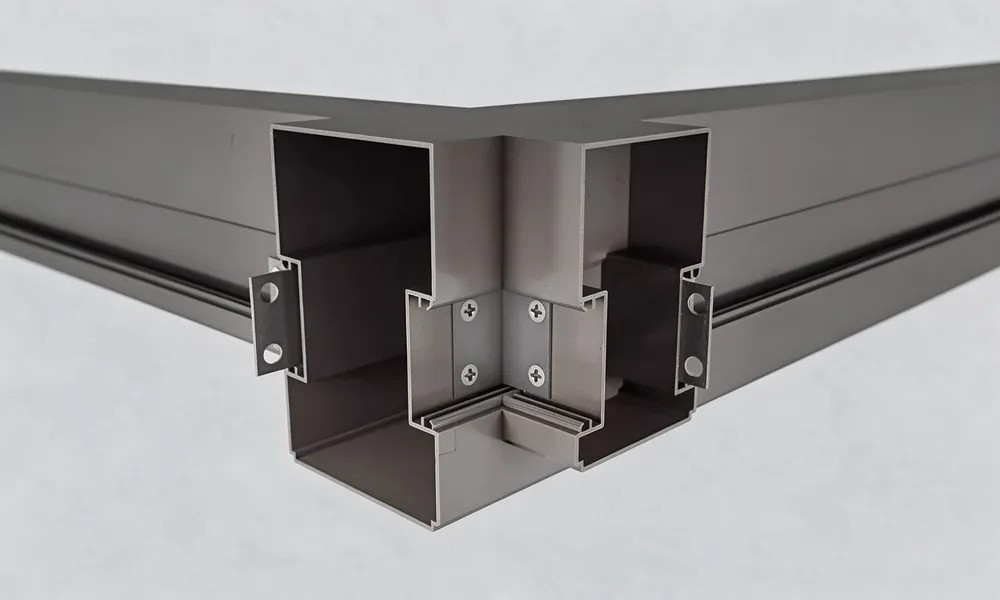
Internal or External Foot: Which Base to Specify
Every post in a louvered pergola meets the ground in one of two ways: with the base plate inside the footprint of the frame, or with the plate extending outside it. Both are called a foot, and the difference decides what the terrace looks like, how the anchor is reached, and whether the frame can be bolted down after the paving is finished.
Internal foot: the plate sits under the post
The plate is set inside the post footprint, so the finished frame shows a post arriving at the paving with a small collar and nothing else. The anchor bolts are inside the post, which means they are accessed from above before the post is closed, or through a service cover depending on the design.
The advantage is visual: the frame reads as a single line and the terrace keeps its surface. The compromise is the anchor detail, which has to be designed to be installed before the post goes on, and re-torqued afterwards. On a domestic terrace this is almost always the right choice.
External foot: the plate shows
The plate extends beyond the post, with anchors visible at its corners. The advantage is access: every bolt can be reached, checked and re-torqued at any time, and the plate can be larger than the post, which spreads the load and takes more uplift. On a coastal or exposed site, that extra plate area is worth having.
The cost is visual. Four plates on a terrace are four visible objects, and they collect water and debris unless they are detailed with a fall and a drain hole. On a commercial installation the trade is usually accepted; on a private terrace it often is not.
Which one the wind decides
Uplift wants plate area and anchor spread; the external foot provides both. A site with a real wind requirement, on a substrate that can take the anchors, is a site where the external foot is the safer detail. An internal foot can be designed for the same load, but the plate is limited by the post section, so the anchor count and size have to do the work instead.
Which one the terrace decides
A finished paved terrace with no appetite for drilling wants the internal foot, or a pad below the paving with the plate buried. A terrace that is being built with the pergola wants whatever detail carries the load best, because the paving can be cut around it during construction.
Sequence matters here: the plate detail has to be settled before the paving, because a plate that arrives after the paving is down is a plate that either sits on top of it or requires it to be lifted.
The detail nobody asks about: the collar
Both foot types need a collar at the post base, and the collar is what keeps water from standing against the coating. A post without a collar collects a ring of water at its base, and that ring is where a coating fails first. A 15 mm collar with a slight fall away from the post is a small moulding with a large effect on service life.
The pad, and how the foot meets it
Both foot types assume a pad that is larger than the plate and level with it. A plate on a pad that is 20 mm below the surrounding paving collects water; a plate on a pad that stands 20 mm proud of it cannot be cleaned and shows a step. The pad top should be set so the plate finishes flush or slightly proud with a fall away from the post, and that is a level decision, not a fixing decision.
On a pad below paving, the hole in the paving has to be cut large enough for the plate, the collar and a finger gap for the sealant. Cutting it tight is the reason a base looks patched rather than built in.
Base plates and the anchor set
The plate is the part that carries the uplift into the anchors, so it should be sized for the load rather than chosen from the post. A 110 by 110 post with a plate that matches the post is a plate with four anchors in a small square, and the lever arm between the anchors is short. An external foot can use a plate wider than the post and move the anchors out, which is exactly what an exposed site needs.
Anchor type follows the substrate: expansion anchors into sound concrete, chemical anchors into thin or unknown concrete, through-bolts with a spreader where the slab can be drilled through. The plate detail and the anchor detail are one decision, and a supplier asking for the substrate is a supplier who understands that.
What a buyer sees ten years later
An internal foot that was sealed properly looks untouched. An external foot that was not detailed with a drain hole has a rust ring on the plate and a stain down the paving. Neither detail fails because of its type; both fail because the water detail was left to site. Ask how the plate drains in the quotation, and the answer tells you whether the supplier has fitted these before.
What to write in the order
Foot type, plate size, anchor type and substrate — four lines. Then the collar detail. A quotation that names the foot but not the plate is a quotation that will be resolved on site, and on site the resolution is usually the one that is in the van.
Related: four things that go wrong when a structure is anchored.
Next step: the three series and their specifications are on the louvered pergola product page. If you already have bay sizes, send them through the contact form for a first price.
Keep reading
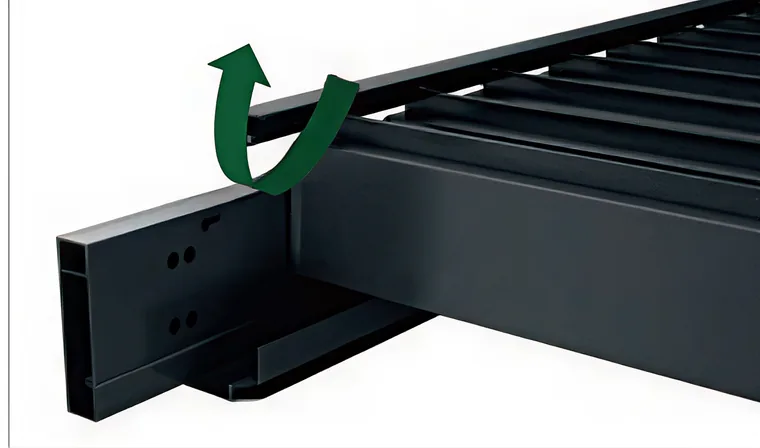
Blade Sections 160×29, 180×35 and 220×45: What Changes
Blade sections on a louvered pergola: 160x29, 180x35 and 220x45, what each spans, how blade count changes shade,…
Read article →
Powder coating vs anodised: what a contractor should actually compare
Both finishes appear on the same drawings and they are not interchangeable. What the difference means after two…
Read article →
What 6063 and 6061 mean when you are specifying aluminium
Two extrusion alloys, two different jobs. Why the number on the drawing matters more than the colour.
Read article →Related notes
- Blade Sections 160×29, 180×35 and 220×45: What Changes
- The Three Span Classes: 3×4, 3.5×5 and 4.5×6.5
- Snow on a Louvered Roof: Load, Clearing and Drainage
Working on a project? Send a drawing and we reply from the Foshan plant with a first price. Not sure which line fits — start from the six product lines.